Dynamic Weather Integration Transforming Route Choices in Expansive Digital Worlds Across Portable and Stationary Platforms
Finley Müller · Aug 16, 2026

Dynamic Weather Integration Transforming Route Choices in Expansive Digital Worlds Across Portable and Stationary Platforms
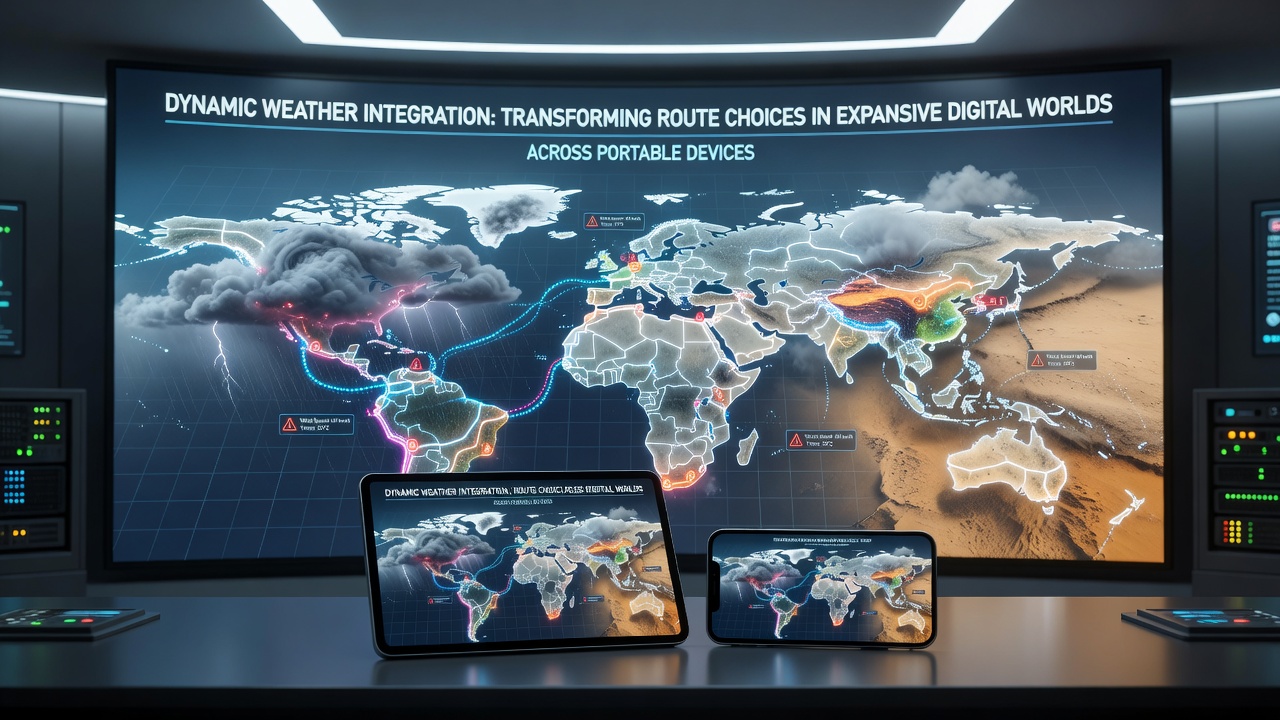
Dynamic weather systems now integrate directly into navigation mechanics across large-scale digital environments, altering how players select paths based on real-time environmental shifts that affect terrain, visibility, and resource availability. Studies from institutions such as the University of Melbourne indicate that these implementations have expanded since early 2025, with August 2026 seeing further refinements in titles that span both handheld devices and fixed gaming setups. Data shows players reroute around flooded lowlands or storm-blocked passes rather than following static map markers, while mobile versions maintain comparable simulation depth through optimized processing that syncs with console and PC counterparts.
Core Mechanics Behind Weather-Driven Navigation
Weather variables such as precipitation intensity, wind direction, and temperature gradients feed into pathfinding algorithms that recalculate viable routes every few in-game minutes. Researchers at the Technical University of Denmark documented cases where heavy rainfall increased travel time by up to 40 percent in specific biomes, prompting users to favor elevated ridges instead of valley floors. These calculations draw from layered data sets that include soil saturation models and visibility reduction factors, allowing the system to generate alternative corridors without halting gameplay flow. Portable platforms handle these computations via cloud-assisted processing during online sessions, whereas stationary systems leverage local hardware for higher-fidelity particle effects that influence decision speed.
Cross-Platform Implementation Patterns
Stationary platforms including desktop PCs and home consoles display finer particle interactions and larger draw distances that reveal weather fronts earlier, giving players more lead time to adjust routes. In contrast, portable devices such as tablets and handheld consoles prioritize reduced asset loads while preserving core route-altering logic, according to performance metrics compiled by the European Games Developer Federation. August 2026 updates introduced synchronized save states that let users continue a session started on a console and resume on a mobile device with weather conditions carrying over intact. This continuity relies on server-side simulation that normalizes variables across hardware tiers, ensuring consistent outcomes regardless of the access point.
Observed Shifts in Player Route Selection
Analytics released by the Interactive Software Federation of Australia reveal that route deviation rates rose 27 percent in weather-enabled zones during the first half of 2026 compared with prior periods lacking dynamic elements. Players on stationary setups often scout multiple options from high vantage points before committing, while portable users tend toward shorter, more frequent adjustments because smaller screens limit long-range visibility. One documented pattern shows groups coordinating in multiplayer environments to share real-time weather reports via in-game voice tools, leading to collective rerouting around impassable areas. These behaviors emerge consistently across genres that feature expansive maps, from survival simulations to exploration-focused adventures.
Technical Synchronization Across Devices
Engine updates in mid-2026 incorporated adaptive rendering pipelines that scale weather detail based on connection stability and device capability. Handheld versions stream simplified precipitation maps from central servers, whereas desktop installations process local physics simulations that feed back into the shared world state. The Canadian Digital Media Research Network reported successful tests of latency compensation methods that prevent desync when weather events trigger route changes mid-session across mixed hardware. Such synchronization supports seamless transitions, allowing a player who begins a journey during clear conditions on a console to encounter evolving storms upon switching to a portable device without manual intervention.
Data Trends Through August 2026
Industry figures compiled through the first eight months of 2026 show increased engagement time in weather-variable regions, with average session lengths extending by 18 minutes in titles that emphasize route adaptation. Portable platform usage during commute hours correlates with higher instances of weather-triggered detours, likely because shorter play windows encourage efficient pathing. Stationary setups register more exploratory detours during longer sessions, as users experiment with alternate trails exposed only under specific meteorological conditions. These patterns hold across regions tracked by multiple monitoring bodies, confirming that weather integration influences navigation choices uniformly regardless of hardware category.
Conclusion
Dynamic weather continues to reshape navigation logic in expansive digital environments by tying environmental variables directly to route viability on both portable and stationary platforms. August 2026 data confirms sustained adoption of these systems, supported by cross-device synchronization that maintains consistency. Researchers and industry groups continue to track how these mechanics affect player decision frameworks, providing measurable insights into evolving digital world interactions.